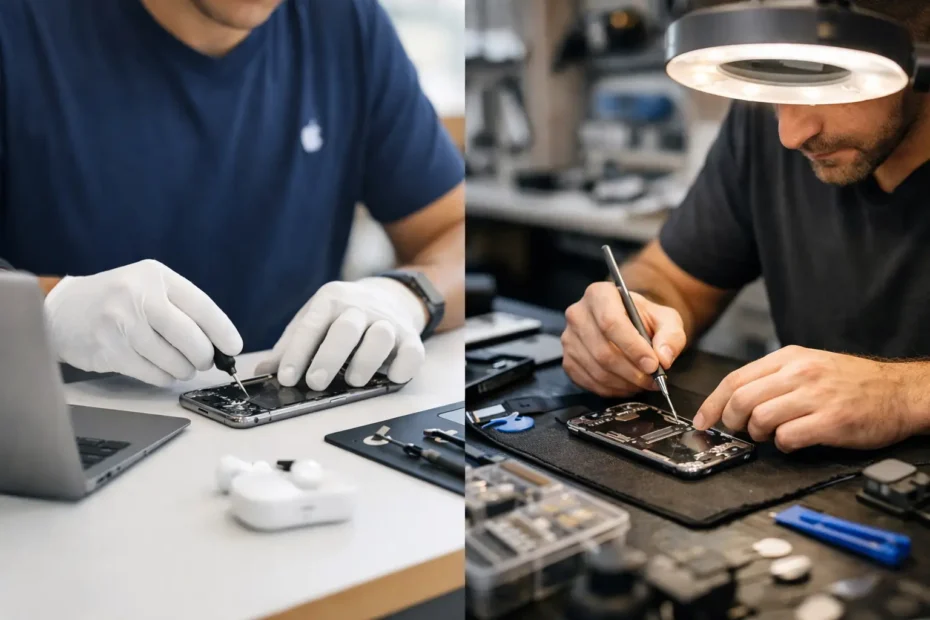
When your Mac stops charging, won’t turn on, or starts acting strange after a spill, the Apple repair vs independent specialist question gets real fast. This is not just about where to drop off a device. It affects cost, turnaround time, whether your data stays intact, and whether the machine gets repaired at all.
For some problems, Apple is a perfectly reasonable choice. For others, an experienced independent specialist is the better answer by a wide margin. The difference usually comes down to repair philosophy, technical depth, and how much effort the shop is willing and able to put into saving the specific Mac you already own.
Apple repair vs independent specialist: what actually changes?
At a high level, Apple is built around standardized service. That model works well when the issue is straightforward and the solution fits Apple’s approved repair path. A battery replacement on a supported model, a display assembly swap, or a warranty-covered defect can fit neatly into that system.
An independent Apple specialist usually works differently. Instead of only following part-for-part replacement paths, a real specialist may perform board-level diagnostics, isolate failed components, clean liquid damage, recover data, or repair the logic board itself. That approach matters when the problem is complex, the model is older, or replacing large assemblies would make the repair too expensive to justify.
So the real choice is not corporate versus local. It is standardized replacement versus repair-first problem solving.
Where Apple service makes sense
Apple has advantages, and pretending otherwise would not help anyone. If your Mac is under AppleCare coverage, the machine is a current model, and the failure falls within Apple’s service framework, going through Apple can be the cleanest option.
You also get consistency. Parts, procedures, and intake are highly structured. If the issue is simple and documented, that structure can work in your favor. For some customers, especially those with a newer Mac and no urgent timeline, that predictability is reassuring.
Apple can also make sense if you are already planning to replace the machine soon and only want an official answer on whether it qualifies for service. In those cases, the decision is less about saving the device long term and more about using the support path attached to the purchase.
The limitation is that Apple service is not usually designed to pursue unusual failures at the component level. If the logic board has a short, a backlight circuit issue, corrosion from liquid exposure, or an isolated failed chip, the standard answer is often replacement of a large assembly or a declaration that the repair is not economical.
Where an independent specialist is often the better choice
If your Mac contains important files, has a liquid damage history, powers on intermittently, shows no backlight, or has already been declined elsewhere, a true specialist often has the edge.
That is because advanced independent shops are usually trying to answer a different question. Apple often asks, “What assembly do we replace?” A specialist asks, “What failed, and can we repair just that?”
This approach can dramatically change the outcome. A logic board replacement can be costly enough to push someone toward buying another Mac. A component-level repair on that same board may save the machine for a fraction of the price. It may also preserve data that would otherwise be lost if the board is swapped or the device is written off.
This is especially relevant for older Macs that are still useful. Plenty of MacBook Pro, MacBook Air, iMac, and Mac mini systems have years of life left if the right problem is fixed properly. A specialist can often keep those machines in service instead of sending customers into an unnecessary replacement cycle.
Cost is not just the repair quote
Most people compare repair options by looking at the number on the estimate. That matters, but it is not the whole picture.
In the Apple repair vs independent specialist decision, cost should include what happens around the repair. If one option replaces a large assembly and another repairs a single failed circuit, the lower quote is obvious. But there are secondary costs too. Downtime matters if you work on your Mac every day. Data loss matters if the machine holds business files, photos, school projects, or client work. The age and value of the device matter as well.
A repair that looks expensive on paper may still be the smarter financial move if it prevents replacing a machine, reconfiguring software, recovering data from backups, and losing days of productivity. On the other hand, if a device has multiple failures and is near the end of its practical life, a good specialist should say that clearly instead of selling false hope.
That honesty is part of the value. A trustworthy independent shop should not push every repair. It should explain what failed, what can be done, what the risks are, and whether the result makes sense.
Turnaround time can be very different
If you rely on your Mac for work, speed is not a luxury. It is part of the repair.
Large service systems can involve intake layers, shipping, queue times, and limited communication during diagnosis. That does not always mean slow service, but it can. Independent specialists often move faster because the person diagnosing the machine is the same person doing the repair, ordering the part, and speaking with the customer.
That direct access reduces wasted time. It also reduces misunderstandings. Instead of getting a generic status update, you may get a clear explanation of what was found and what the next step should be.
For customers in the Orlando area dealing with urgent Mac issues, that difference is not minor. A fast, accurate diagnosis can save a workweek.
Data safety is often the deciding factor
Many customers do not care about repair strategy until they realize their files are at risk.
If the Mac is not powering on, if liquid reached the board, or if the storage is tied closely to the failed hardware, data recovery becomes part of the repair conversation. This is where specialist-level skill matters most. A shop that understands board faults, corrosion patterns, and power rail issues has a better chance of restoring access to the drive or reviving the machine long enough to secure the data.
Apple’s service path is not generally built around custom data-preservation efforts on damaged boards. A specialist often is.
That does not mean every case is recoverable. Some liquid-damaged or electrically damaged Macs are too far gone. But if the files matter, you usually want the technician who is trying to save the board first, not simply replace it.
Communication matters more than people expect
Repair anxiety usually comes from uncertainty. Customers want to know what failed, what it costs, how long it takes, and whether the answer they are hearing is real.
A strong independent specialist has an advantage here because communication can be direct and technical without becoming confusing. You can ask real questions and get real answers. That matters when your Mac is not just a gadget. It is your office, your design station, your school computer, or your family archive.
This is one reason many people prefer working with a business like YourMac.Repair. You are not getting routed through a generic front desk and then waiting for a vague update. You are dealing with someone who understands the repair itself and can explain the trade-offs honestly.
How to decide which option fits your Mac
Start with the age of the machine and the type of problem. If it is a newer Mac with warranty coverage and a routine issue, Apple may be the right first stop. If the machine is out of warranty, has liquid damage, a logic board issue, no power, no backlight, or a problem another shop could not solve, an independent specialist is usually worth contacting first.
Next, think about the value of your data and your time. If either one is high, avoid choosing based only on the most convenient intake process. Choose based on who is most likely to preserve your files and return a working machine quickly.
Finally, listen to how the repair is explained. Good shops do not hide behind vague language. They tell you what they know, what they suspect, and what the likely repair path looks like. That level of transparency usually tells you a lot about what the experience will be like.
The best repair choice is the one that matches the actual failure, not the biggest brand name. If your Mac needs a standard covered repair, use the standard path. If it needs skill, patience, and component-level work, choose the specialist who is built for that job.
Need Mac or iPhone repair in Winter Garden / Orlando?
YourMac.Repair — board-level Apple repair with honest diagnosis and fast turnaround. We say YES when Apple says NO.
- Mac Logic Board Repair — liquid damage specialist
- Mac Screen Repair
- Mac Battery Replacement
- Mac & PC Data Recovery
- iPhone Screen Repair — same-day service
📞 (407) 580-9965 · WhatsApp · 819 Marsh Reed Dr, Winter Garden, FL 34787