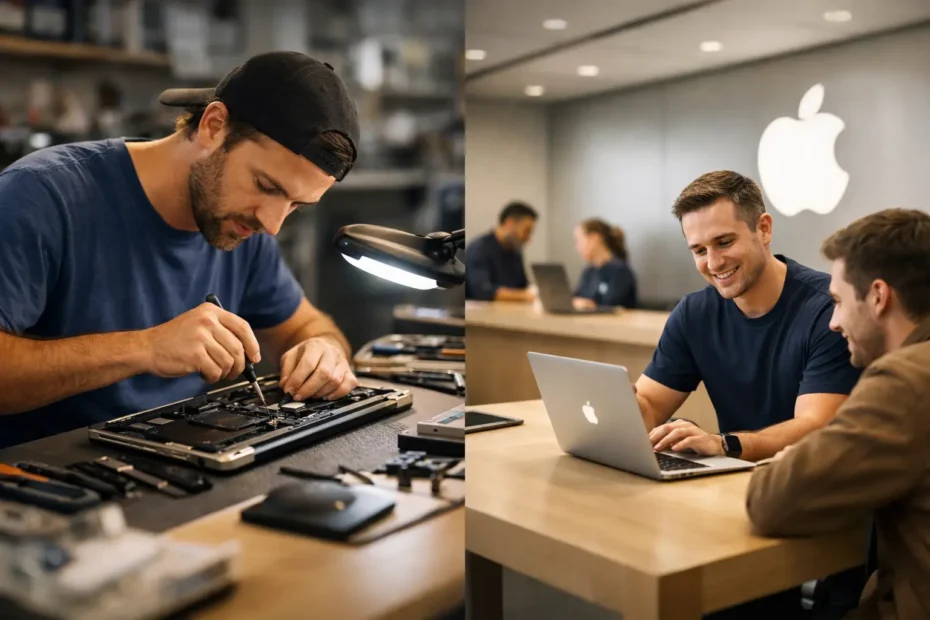
When your Mac stops charging, shows no backlight, takes a spill, or suddenly won’t power on, the choice between independent Mac repair vs Apple gets real fast. This isn’t just about where to drop off a laptop. It’s about whether your data is protected, whether the machine is actually repairable, how much you’ll spend, and whether anyone will even try to save the board before recommending a replacement.
Independent Mac repair vs Apple: what actually changes?
On the surface, both options promise a fix. In practice, they often approach the same problem very differently.
Apple service is built around standardized procedures. That has advantages. If your Mac is under warranty or covered by AppleCare+, Apple is often the first place to check. For common issues on newer models, that path can be simple and predictable. You know the process, the parts source, and the general expectations.
Independent Mac repair shops vary, which means quality matters, but the right specialist can offer something Apple usually does not: component-level diagnosis and repair. That matters most when the issue is deeper than a bad battery or a cracked screen. If a logic board has liquid damage, a charging circuit fault, a short, or a backlight problem, a repair-first shop may be willing to isolate the failed component instead of replacing an entire assembly.
That difference can mean hundreds of dollars saved, faster turnaround, and a much better chance of keeping your original data intact.
Cost is usually the first question
For many Mac owners, the biggest difference in independent Mac repair vs Apple is price. Apple often replaces larger assemblies instead of repairing at the board level. That can be efficient from a corporate service standpoint, but it can also make a repair quote jump quickly.
If a single failed chip on a logic board is causing a no-power condition, a skilled independent technician may be able to repair that section without replacing the whole board. Apple’s solution in the same situation may be a full logic board replacement, assuming the model is still supported and parts are available.
That does not mean independent repair is always cheaper in every case. A straightforward battery replacement or display replacement on certain models may come out fairly close depending on parts quality and labor. But once the issue becomes complex, especially with liquid damage or board faults, the pricing gap can widen.
A fair comparison is not just the initial estimate. It is also the value of keeping your Mac, your data, and your workflow intact without being pushed toward a replacement device.
Turnaround time depends on the problem
People often assume Apple will be faster. Sometimes that’s true. Sometimes it isn’t.
For routine, in-stock repairs, Apple or an authorized provider may move quickly. But there are also cases where devices are shipped out, queued, or delayed by parts availability and approval processes. If you rely on your Mac for work, school, editing, bookkeeping, or client communication, even a few extra days matters.
An experienced independent shop can sometimes diagnose and complete repairs much faster, especially when you are speaking directly with the technician doing the work. That direct access cuts out a lot of guesswork. You can describe the symptoms, explain what happened before failure, and get a more realistic idea of what is repairable and what is not.
For urgent cases, speed is not just convenience. It is business continuity.
Apple is strong on standardized repair. Independents are strong on problem solving.
This is the clearest dividing line.
Apple’s system is designed for consistency. If your Mac needs a supported part replacement under a known service path, that structure works well. It is less flexible when the failure falls outside that path.
Independent specialists, especially those focused on Mac board repair, are often better equipped for problems that do not fit a standard checklist. That includes no power, no image, no backlight, liquid intrusion, charging failures, keyboard damage after a spill, and data recovery from systems that appear dead.
A good technician is not just swapping parts. They are tracing faults, testing rails, checking for corrosion, validating whether a repair is stable, and making judgment calls based on experience.
That matters because not every broken Mac needs a full assembly replacement. Sometimes it needs someone willing to look closer.
Data risk is where the decision gets personal
For a lot of customers, the real issue is not the hardware. It is what is on it.
If your Mac contains tax records, business files, school projects, music sessions, family photos, or years of client work, repair decisions carry more weight. In some Apple repair scenarios, especially those involving board replacement, your original data may not be preserved unless you already have a current backup.
That is one of the most practical reasons people choose an independent specialist. Repair-first diagnostics can increase the odds of keeping the original board functioning long enough to recover data, or in some cases restore normal operation entirely.
No honest technician should promise recovery in every case. Some boards are too far gone. Some storage devices are damaged beyond repair. But when data matters, it makes sense to choose a shop that treats preservation as part of the job instead of assuming replacement is the only answer.
Older Macs are a major dividing line
If you own an older MacBook Pro, MacBook Air, iMac, or Mac mini, Apple may classify it as vintage or obsolete depending on the model. That changes support options fast.
Independent repair shops often continue servicing older systems long after manufacturer support narrows. That can include SSD upgrades, internal cleaning, thermal paste replacement, battery replacement on older units, and even macOS upgrades for unsupported models when the hardware is still worth keeping.
This is not about holding on to outdated hardware for sentimental reasons. Many older Macs still have plenty of life left for office work, school, browsing, bookkeeping, design, and home use. If the machine is structurally sound, extending its life can be far more sensible than replacing it.
It depends on the model, the condition, and what you need it to do. But age alone should not decide whether a Mac is worth saving.
Parts, quality, and expectations
One concern people have with independent repair is parts quality. That is a fair question.
Apple uses its own service ecosystem and standardized supply chain. Independent shops may use original pull parts, premium aftermarket parts, or a mix depending on the repair. The right answer is transparency. You should know what kind of part is being used, what the expected performance is, and whether there is a warranty on the work.
A trustworthy shop will explain the trade-offs clearly. For example, some aftermarket screens are perfectly reasonable. Others are not. Some repairs are best done with original parts from donor boards. Others can be completed reliably with high-quality replacement components.
The issue is not whether a repair is done by Apple or independent. The issue is whether the person doing the work is being honest about the method, the risks, and the expected result.
Communication is often the deciding factor
One of the biggest frustrations Mac owners have is being stuck between a front desk, a ticket system, and a vague status update. When your device is down, generic answers are not very helpful.
That is where a specialist-led independent shop stands out. When you can talk directly to the technician, you get better context. You can ask whether the board is repairable, whether liquid damage has spread, whether your data is likely safe, and whether the repair makes financial sense.
That kind of direct communication is hard to fake. It builds trust because the person diagnosing the issue is the same person explaining it.
For customers in Central Florida dealing with serious Mac failures, that hands-on approach is often the difference between a clean decision and a frustrating one. Shops like YourMac.Repair built their reputation on that exact model: direct access, transparent diagnosis, and advanced Mac repair that does not default to replacement when a real repair is possible.
So which option makes sense?
If your Mac is under warranty, the issue is straightforward, and data is backed up, Apple may be the cleanest route. There is nothing wrong with that.
If the Mac is older, out of warranty, liquid damaged, dead, intermittently failing, or holding important data, an independent Mac specialist usually gives you more repair paths. That does not guarantee a save, but it does increase the chance that someone will actually try to repair the problem at the component level instead of writing the machine off.
That is the real answer to independent Mac repair vs Apple. One model is built for standardization. The other, when you choose the right specialist, is built for diagnosis, flexibility, and saving devices that still have life left.
When your Mac fails, the best next step is not guessing. It is getting an honest diagnosis from someone who knows the difference between a machine that needs a replacement and one that is still worth repairing.
Need Mac or iPhone repair in Winter Garden / Orlando?
YourMac.Repair — board-level Apple repair with honest diagnosis and fast turnaround. We say YES when Apple says NO.
- Mac Logic Board Repair — liquid damage specialist
- Mac Screen Repair
- Mac Battery Replacement
- Mac & PC Data Recovery
- iPhone Screen Repair — same-day service
📞 (407) 580-9965 · WhatsApp · 819 Marsh Reed Dr, Winter Garden, FL 34787