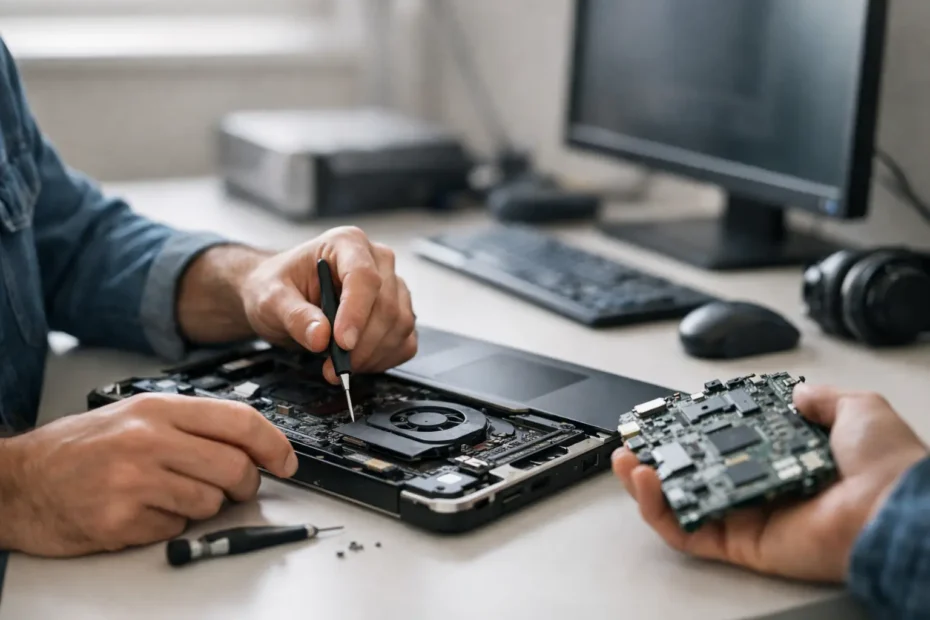
Your laptop stops charging, the screen goes dark, or one spilled coffee suddenly turns a working machine into a very expensive paperweight. That is usually the moment people start asking why manufacturers don’t want you to fix your device and push you to a new one instead. The short answer is simple: replacement is often more profitable, easier to standardize, and better for their sales model than real repair.
For the customer, though, that logic rarely makes sense. If your Mac still holds years of work, photos, client files, and settings you depend on, being told to replace the whole machine can feel less like support and more like a sales pitch.
Why manufacturers don’t want you to fix your device
Most major device brands are built around volume. They design, market, and sell new hardware at scale. Repair, especially advanced repair, does not fit neatly into that system. Component-level troubleshooting takes time, skilled labor, and accurate diagnosis. It is not as predictable as swapping out an entire module or recommending a new device.
That is one reason many companies limit access to parts, schematics, diagnostic tools, and repair documentation. If independent specialists and customers can repair devices properly, more devices stay in service longer. That is good for the owner, but it can reduce replacement sales.
There is also the issue of control. When a manufacturer controls the parts pipeline, the repair process, and the official service options, it controls pricing too. A customer who is quoted a very high repair cost may decide a new device is the better deal, even if the original issue could have been fixed more affordably by a qualified specialist.
The business reasons behind the push to replace
Not every replacement recommendation is dishonest. Sometimes a device really is beyond economical repair. But very often, the system is set up to favor replacement before true repair is even explored.
One reason is labor. Board-level repair is specialized work. Finding a failed charging circuit, backlight issue, corroded component, or short on a logic board requires training and experience. That is very different from replacing a battery, screen, or entire board assembly. Manufacturers and large service networks often prefer workflows that are fast, repeatable, and low-risk for their operation.
Another reason is inventory strategy. It is easier to stock complete assemblies than individual chips and tiny board components. From a corporate standpoint, replacing whole sections is simpler. From the customer standpoint, it can turn a fixable issue into an expensive repair quote.
Then there is product lifecycle pressure. Companies release new models constantly. If devices remain repairable for many more years, the urgency to upgrade drops. That does not mean every manufacturer is acting in bad faith. It does mean their incentives are not always aligned with yours.
Why this hits Mac owners especially hard
Apple devices are well-built, but they are also highly integrated. Storage, keyboards, batteries, displays, and logic board functions are often tied closely together. That design can improve performance and size, but it can also make repair more difficult and more dependent on specialist knowledge.
For Mac owners, the real cost of replacement is not just the new machine. It is downtime, software setup, account migration, workflow disruption, and possible data loss. A designer, student, business owner, or remote worker may lose far more from interruption than from the repair bill itself.
This is where the gap between manufacturer service models and independent repair becomes obvious. If a shop only follows a replace-the-module approach, many recoverable devices get written off too early. A technician with real logic board repair and data recovery experience as YourMac.Repair provides may see a path forward where others do not.
What repair-first service looks like
A real repair-first approach starts with diagnosis, not assumptions. Instead of jumping straight to replacement, the technician finds out what actually failed and whether that failure can be corrected safely and cost-effectively.
Sometimes the fix is straightforward, like a battery, keyboard, or screen replacement. Sometimes it is deeper, such as liquid damage cleanup, micro-soldering, power rail diagnosis, thermal servicing, or recovering data from a Mac that will not boot. These are not theoretical services. They are the difference between replacing a machine and keeping your existing one working.
That is why many customers look for specialists instead of retail counters. At YourMac.Repair, for example, customers speak directly with Eduardo, a technician with decades of Apple experience, rather than getting filtered through a generic intake process. That direct access matters when your problem is complex and your data is valuable.
When replacing your device does make sense
Repair is not always the best answer. If the repair cost is too close to the value of the machine, if parts are no longer viable, or if your needs have significantly outgrown the hardware, replacement may be the smarter move.
But that decision should come after an honest evaluation, not before one. A trustworthy repair specialist will tell you when a repair makes sense, when it does not, and what the tradeoffs are. That kind of transparency is what many customers are missing when they are pushed toward a new device too quickly.
The real question to ask
The issue is not whether manufacturers ever recommend replacement for valid reasons. Sometimes they do. The better question is whether you were given a real repair option in the first place.
If the answer is no, then the quote you received may reflect a business model, not the full truth about your device. For anyone dealing with a failing Mac, especially one with important files or expensive hardware, that distinction matters. The right diagnosis can save money, save data, and save a machine that still has plenty of life left in it.
Need Mac or iPhone repair in Winter Garden / Orlando?
YourMac.Repair — board-level Apple repair with honest diagnosis and fast turnaround. We say YES when Apple says NO.
- Mac Logic Board Repair — liquid damage specialist
- Mac Screen Repair
- Mac Battery Replacement
- Mac & PC Data Recovery
- iPhone Screen Repair — same-day service
📞 (407) 580-9965 · WhatsApp · 819 Marsh Reed Dr, Winter Garden, FL 34787