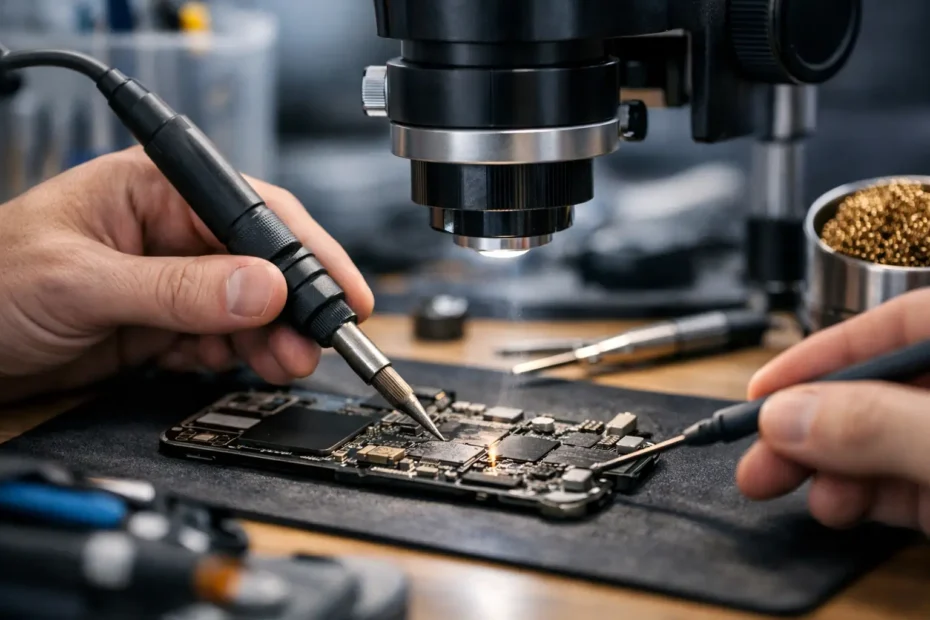
A few years ago, many Apple device failures were treated like dead ends. No power, no backlight, liquid damage, random shutdowns, and charging issues often meant one recommendation – replace the whole board or replace the whole computer. That is exactly why micro soldering trends for Apple repairs matter right now. They are changing what can be saved, how accurately faults can be diagnosed, and how often customers can avoid a much more expensive replacement.
For Mac owners, this is not just a technical shift. It affects repair cost, turnaround time, data recovery chances, and whether a trusted machine gets back to work or ends up recycled before its time. For repair shops that actually work at board level, the biggest trend is simple: better diagnosis is becoming just as valuable as better soldering.
Why micro soldering is becoming more central
Apple hardware keeps getting denser, more integrated, and less forgiving of rough repair methods. On modern MacBooks and desktops, a single failed component on the logic board can create symptoms that look much bigger than they are. A short on a power rail, a damaged capacitor after a spill, or a bad backlight circuit can make a device appear beyond repair when the real fault is much more specific.
That is why micro soldering is no longer a niche specialty tucked away behind standard repair work. It is becoming a core service for shops that want to solve difficult Apple problems instead of swapping assemblies and hoping for the best. The change is especially noticeable in cases involving liquid exposure, battery line faults, USB-C charging issues, and display power circuits.
There is also a customer-side shift. More people now understand that Apple board repair is possible. They are asking better questions. Instead of accepting “needs a new board,” they want to know what failed, whether their data is safe, and whether a component-level repair can extend the life of the machine.
Micro soldering trends for Apple repairs that are shaping real outcomes
The most important trend is the move away from guesswork. Good board repair today is built on thermal imaging, current draw analysis, diode mode readings, boardview access, known failure patterns, and experience with Apple-specific circuitry. The soldering iron still matters, but it is part of a larger diagnostic process.
That matters because the cleanest soldering job in the world will not fix the wrong fault. On a MacBook with no power, for example, the issue may be a shorted capacitor, a damaged CD3217 or CD3215 charging controller on certain USB-C models, corrosion under a controller chip, or a problem deeper in the power sequence. Repair quality now depends on finding the right target before heat ever touches the board.
Another trend is more selective component replacement. Skilled technicians are increasingly replacing only the failed part and addressing any surrounding damage, rather than performing broad, unnecessary rework. This lowers risk when done properly. Every time a board is heated, there is some level of stress involved. Precision matters.
There is also a growing focus on post-liquid-damage stabilization. A spill is rarely just one event. Corrosion can continue long after the device seems to dry out, and delayed failures are common. Better repair practices now include cleaning, corrosion assessment, tracing damaged lines, replacing affected components, and checking whether the original fault caused secondary issues elsewhere on the board. That approach gives customers a more honest picture of what is repairable and what may still carry some uncertainty.
The rise of repair-first thinking
One of the clearest trends in Apple repairs is that more customers want repair-first options before paying for full replacement. That is especially true with MacBook Pro, MacBook Air, iMac, and Mac Mini systems holding business files, school projects, creative work, or years of personal data.
A repair-first mindset does not mean every board should be repaired. Some boards are too far gone. Severe corrosion, multiple torn pads, prior bad repair attempts, or major internal damage can make a repair impractical. But the trend is moving in a healthier direction: evaluate the actual board condition first, then recommend the most sensible path.
For customers, this often means better value. A component-level repair can cost far less than replacing a complete logic board, especially on higher-end Apple hardware. It can also preserve original data when storage is tied closely to the board, which is a major factor on many newer Macs.
Apple silicon and denser board design are raising the bar
As Apple hardware evolves, micro soldering work is becoming more demanding. Apple silicon machines offer impressive performance and efficiency, but they also bring tighter integration. That can make diagnostics more complicated and unsuccessful repairs more expensive if handled carelessly.
This trend is pushing the industry in two directions at once. On one side, there is more opportunity for specialists who truly understand board-level repair. On the other, there is less room for general repair shops to experiment beyond their skill level. A modern Apple board is not a practice surface.
That is one reason direct communication with the technician matters. When a customer can speak with the person actually diagnosing the board, they get a clearer explanation of the fault, the repair strategy, the risk level, and whether the goal is full repair, data recovery, or both. In advanced Apple repair, clarity builds trust.
Data recovery is becoming part of the micro soldering conversation
Years ago, many customers saw micro soldering as purely a repair service. Now it is increasingly tied to data recovery. If a Mac will not power on and the data is critical, board-level work may be the only realistic path to getting that data back.
This is especially true on systems where storage is not easily removable. In those cases, even a temporary board recovery can be valuable if it allows access to the drive long enough to back up important files. Not every repair needs to return the machine to long-term daily use. Sometimes the goal is narrower and still extremely important.
That changes how a specialist approaches the work. A permanent fix and a data-recovery-focused repair are not always the same thing. Customers deserve to know the difference so expectations stay realistic.
Better tools help, but experience still decides the result
The tools used in micro soldering have improved. Microscopes are clearer. Thermal cameras are more accessible. Precision hot air and soldering stations are better controlled. Ultrasonic cleaning and microscope inspection are now standard in serious board repair environments.
Even so, better equipment does not automatically produce better repairs. The hard part is interpretation. Knowing what a thermal anomaly means, when corrosion is cosmetic versus destructive, or when a board has hidden layer damage takes experience. Apple repair is full of cases where two devices show the same symptom and require completely different fixes.
That is why customers should be cautious about repairs that sound too certain before proper testing. Fast answers can be helpful, but honest diagnosis is more valuable than confident guessing. A good technician will explain what is confirmed, what is likely, and what still needs to be verified.
What customers should expect from modern micro soldering work
Today, strong board-level repair service should feel more transparent than mysterious. Customers should expect a clear explanation of the problem, a realistic estimate, and honest discussion about the chances of repair. They should also expect someone to tell them when a board has poor odds and is not worth sinking money into.
Micro soldering trends for Apple repairs are moving toward exactly that kind of service. Less parts-swapping. More evidence-based diagnosis. More effort to save original devices. More attention to data preservation. And more value for customers who would rather repair a Mac properly than replace it unnecessarily.
For people in Central Florida dealing with difficult Apple failures, that shift matters because it creates options where other shops may only offer a dead end. At YourMac.Repair, that kind of work is handled directly by Eduardo, not passed through a counter script, which is often the difference between a generic answer and a real solution.
If your Mac has a no-power issue, backlight failure, charging problem, or liquid damage, the right question is not just whether it can be repaired. The better question is whether someone with true board-level experience has actually looked at the fault closely enough to give you the right answer.
Need Mac or iPhone repair in Winter Garden / Orlando?
YourMac.Repair — board-level Apple repair with honest diagnosis and fast turnaround. We say YES when Apple says NO.
- Mac Logic Board Repair — liquid damage specialist
- Mac Screen Repair
- Mac Battery Replacement
- Mac & PC Data Recovery
- iPhone Screen Repair — same-day service
📞 (407) 580-9965 · WhatsApp · 819 Marsh Reed Dr, Winter Garden, FL 34787