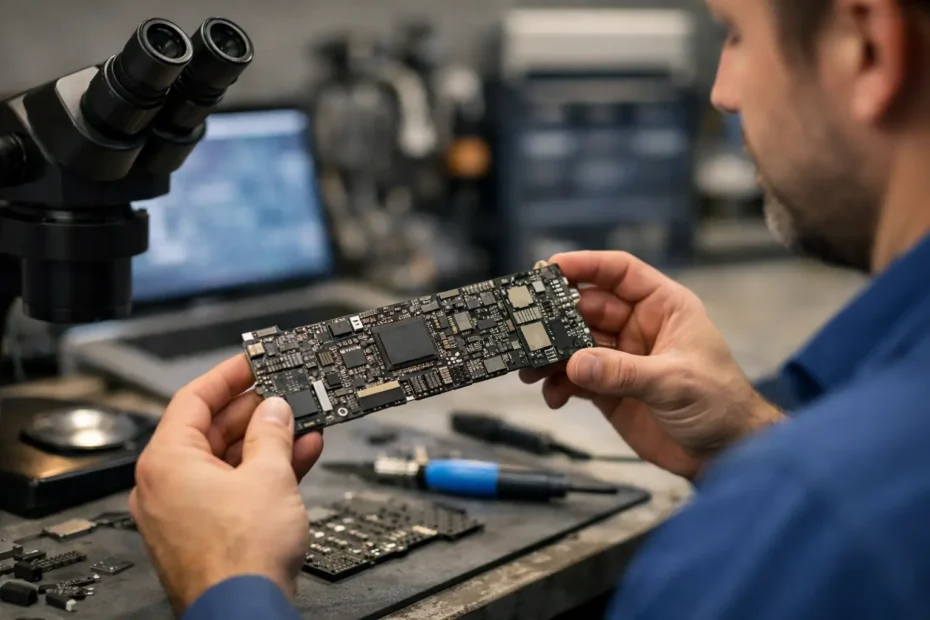
A dead MacBook rarely fails at a convenient time. It stops turning on the night before a deadline, after a coffee spill, or right when years of photos and work files are trapped inside. That is why a real logic board repair success story matters. It shows the difference between being told to replace the computer and having someone actually trace the fault, repair the board, and bring the machine back.
For many Mac owners, the first diagnosis is not really a diagnosis. It is a replacement quote. If a machine has no power, no backlight, liquid damage, or signs of board failure, the easy answer is often a full logic board replacement or a new device altogether. That approach is fast for the shop, but it is expensive for the customer and often unnecessary.
A true board-level repair works differently. Instead of swapping major assemblies, the technician isolates the failing circuit, tests surrounding components, and repairs the board at component level when the damage is limited enough to make sense. Sometimes that means replacing a shorted capacitor. Sometimes it means repairing a corroded area after liquid exposure. Sometimes it means addressing a power rail issue that keeps the Mac completely dead. The point is simple – not every failed logic board needs a full replacement.
What a logic board repair success story usually starts with
Most successful cases begin with uncertainty, not certainty. The customer usually knows the symptom, not the cause. A MacBook Pro may be completely dead. A MacBook Air may chime but show no image. An iMac may shut down randomly or refuse to charge. In many cases, the customer has already heard some version of, “It needs a new board,” or, “It is not worth fixing.”
That is where real diagnostics matter. A skilled technician does not jump from symptom to price quote. The process starts with inspection, power measurement, current draw behavior, visual assessment under magnification, and targeted testing around known failure points. On liquid-damaged boards, corrosion may be obvious, but the visible damage is not always the whole story. On no-power cases, the failed part might be tiny and inexpensive, even though the symptom looks catastrophic.
This is also where honesty matters. Not every board can or should be repaired. Severe multilayer damage, burned pads, prior bad repair attempts, or widespread corrosion can push a device beyond practical recovery. A trustworthy repair shop says that clearly. The value is not in promising miracles. It is in knowing the difference between a repairable board and a money pit.
Why some Macs get saved while others get replaced
The biggest factor is not luck. It is the quality of the diagnosis.
A replacement-focused workflow treats the logic board like a sealed part. If it fails, the whole thing goes. A repair-first workflow treats the board like an electrical system with testable sections and repairable failures. That shift changes the outcome for a lot of customers, especially when the issue involves power circuits, charging problems, backlight faults, and moderate liquid damage.
There are trade-offs. Component-level repair takes skill, proper tools, and time. It is not always same-minute work, and no honest technician should guarantee success before testing is complete. But when the board is a good candidate, repair is often far more cost-effective than replacing the machine or installing an expensive donor board with an unknown history.
It also preserves continuity. The customer keeps the same Mac, the same fit and finish, and in many cases the same internal storage and data environment. For business users, students, and remote workers, that can matter just as much as the hardware savings.
The real value behind a repair success story
When people hear “success story,” they often think of a dramatic before-and-after. The computer was dead, then it worked. That part matters, but the deeper value is in what the repair prevents.
A successful logic board repair can prevent unnecessary replacement costs. It can avoid losing access to important files. It can keep an older but still useful Mac in service for years longer. It can also save customers from bad second opinions, especially after they have been told there are no options left.
That is especially true in liquid damage cases. Spills do not all behave the same way. Some cause immediate shutdown. Others leave residue that slowly corrodes circuits over time. A machine may seem fine for days and then fail later. In those cases, fast and proper treatment matters. Cleaning alone is sometimes enough if caught early. In other cases, affected components need to be replaced and damaged areas stabilized before the board can operate reliably again.
The same goes for no-power Macs. From the customer side, a dead machine is a dead machine. From the repair side, there is a huge difference between a short on a low-voltage rail and severe CPU-area damage. One may be very repairable. The other may not be. A good shop does not blur those together.
What customers should look for in a logic board repair success story
Not all repair claims mean much. If you are trying to judge whether a shop can really handle advanced Mac failures, the useful signs are specific.
Look for signs of actual board-level capability, not just broad promises. That includes no-power diagnostics, liquid damage treatment, backlight repair, micro-soldering, and data-conscious handling. It also helps when you can speak directly with the person doing the work rather than going through a sales counter that cannot explain the diagnosis.
Transparency matters too. A credible shop should explain what was found, what was repaired, what risks remain, and whether the fix is stable or temporary. Some liquid damage repairs, for example, are excellent saves but still carry long-term uncertainty depending on how far corrosion spread before service. Saying that out loud builds trust.
Price is another clue. Fair pricing does not mean the cheapest quote. It means paying for skilled diagnostics and repair work that make sense relative to the value of the machine. If the repair cost approaches replacement value, a good technician should say so. If the fault is minor and fixable, that should be reflected too.
Why direct access to the technician changes the outcome
This is one of the most overlooked parts of a successful repair. When customers can talk directly with the specialist, the process gets better on both sides.
The technician can ask better questions about what happened before failure, whether there was a spill, whether the charger got hot, whether the machine had intermittent symptoms, or whether another shop already worked on it. Those details can speed up diagnostics and prevent wrong assumptions.
The customer, meanwhile, gets a clearer answer. Not a scripted estimate. Not a vague note that says “board issue.” A real explanation of what is happening and whether repair is realistic. That kind of communication is a major reason specialized shops outperform general service counters on difficult Mac cases.
At YourMac.Repair, that direct specialist access is part of the value. Customers work with Eduardo, a technician with decades of Apple experience, not a front desk relay system. For complex repairs, that matters.
A better way to think about Mac repair
The lesson behind any logic board repair success story is not that every failed Mac can be saved. It is that many can be saved when the person diagnosing it has the skill to go beyond replacement logic.
That matters for newer Macs with high replacement cost, but it also matters for older models that still fit the owner’s needs. A machine does not have to be the latest model to be worth repairing. If the display is good, the storage matters, and the overall condition is strong, a targeted board repair can be the smartest option on the table.
It also gives customers back some control. Instead of accepting a yes-or-no answer from a system built around replacement, they get a more precise question: what actually failed, and is that failure repairable at a fair cost?
That is a much better place to start.
If your Mac has been written off, the useful next step is not guessing. It is getting a real diagnosis from someone who understands board-level repair well enough to tell you when a save is possible and when it is not. Sometimes the difference between a dead machine and a working one comes down to one small failed component – and the experience to find it.
Need Mac or iPhone repair in Winter Garden / Orlando?
YourMac.Repair — board-level Apple repair with honest diagnosis and fast turnaround. We say YES when Apple says NO.
- Mac Logic Board Repair — liquid damage specialist
- Mac Screen Repair
- Mac Battery Replacement
- Mac & PC Data Recovery
- iPhone Screen Repair — same-day service
📞 (407) 580-9965 · WhatsApp · 819 Marsh Reed Dr, Winter Garden, FL 34787