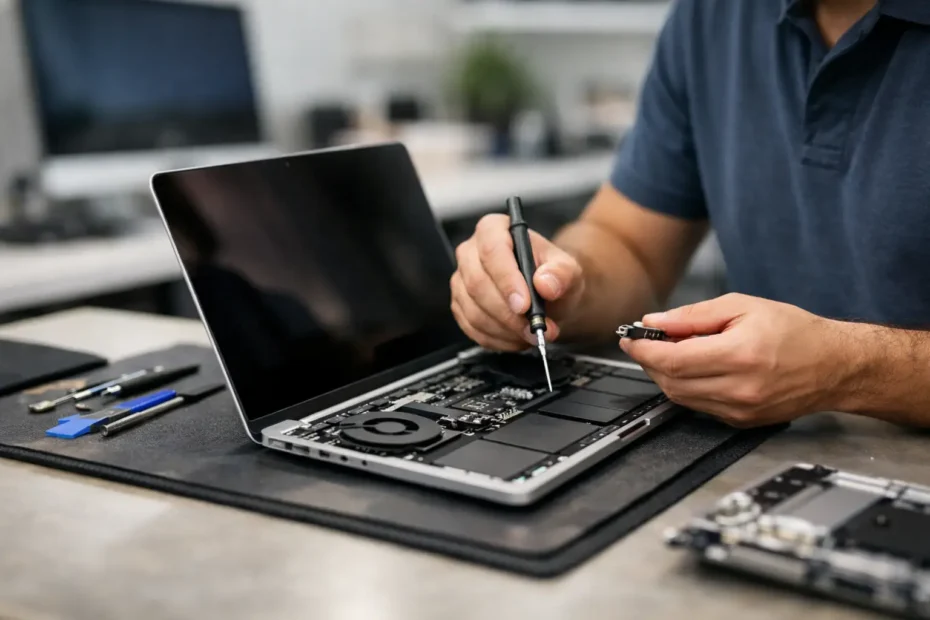
A Mac that fails in the middle of a workday rarely fails at a convenient time. If you are searching for same day mac repair, you are probably not casually comparing options. You need your files, your apps, your client work, your class notes, or simply your machine back without getting trapped in a long intake process or being told the only solution is replacement.
That urgency is real, but so is the need for good judgment. Same-day service can be excellent when the problem is diagnosed correctly and the repair is done by someone who understands Macs at a deeper level than part swapping. It can also be misleading when a shop promises speed before they know what actually failed.
When same day mac repair is realistic
Some Mac problems are genuinely good candidates for same-day turnaround. A battery replacement on a supported model, a screen replacement when the part is in stock, a keyboard issue limited to a known assembly problem, or an internal cleaning with thermal compound replacement can often be handled quickly. The same goes for SSD upgrades on compatible machines and many software-related issues such as macOS reinstallations, startup failures, migration problems, and unsupported macOS upgrades when there are no hidden hardware faults.
These jobs are faster because the failure is easier to confirm, the repair path is clear, and the parts or tools are usually available. In those cases, speed comes from experience and preparation, not guesswork.
The best shops do not treat every repair the same. They know the difference between a predictable repair and one that needs bench time, board inspection, liquid damage evaluation, or data recovery precautions. That is what separates honest same-day service from empty promises.
When fast repair depends on diagnosis
A MacBook that will not power on, an iMac with no backlight, a machine that got wet, or a device stuck in a boot loop may still be repairable quickly, but it depends on what the diagnostic process finds. These are the cases where customers often hear “it needs a new board” from one place and get an actual board-level repair somewhere else.
Logic board issues are a good example. A no-power condition might be caused by a failed charging circuit, corrosion from an old spill, a shorted rail, or damage around a critical chip. Those are not all-day repairs by default, but they are not one-size-fits-all either. The right technician can often identify the fault faster than a general repair counter because they know where Macs commonly fail and how to test those areas properly.
Liquid damage is similar. Sometimes the machine only needs ultrasonic cleaning, a connector repair, and a few replaced components. Sometimes corrosion has spread further than it first appears. A shop that is serious about repair-first service will tell you which situation you are in before pushing an expensive replacement path.
What actually slows down a Mac repair
Customers often assume repair time is mostly about labor. In reality, turnaround usually depends on three things: diagnosis, parts availability, and the repair philosophy of the shop.
Diagnosis is first because the symptom is not always the problem. A MacBook that randomly shuts down may have a battery issue, a thermal issue, board damage, or even file system corruption. If a shop skips proper testing, same-day service can turn into repeat visits or wasted money.
Parts availability matters next. If a screen, battery, keyboard, or trackpad is in stock, the repair can move quickly. If the part has to be ordered, same-day is off the table no matter how good the technician is. A trustworthy shop says that plainly.
Repair philosophy matters more than most people realize. Some places replace whole assemblies because it is easier for their workflow. That may be faster in some cases, but it can also be far more expensive and unnecessary. Other shops work at the component level when that makes sense. That approach often saves machines that would otherwise be written off, especially for logic board faults, spill damage, and no-backlight problems.
Same day mac repair is not just about speed
Fast service only helps if the repair holds up. For Mac owners, especially professionals and students, the bigger question is whether the shop understands what is at stake. Your Mac is not just hardware. It may contain active projects, photo libraries, accounting data, music sessions, legal records, or years of personal files.
That is why good repair service starts with the right priorities. If the data is critical, the repair strategy should reflect that. If the machine is unstable but still boots, preserving access to the drive may matter more than rushing into invasive work. If the issue is liquid damage, every hour matters, but so does avoiding further corrosion and unnecessary power-on attempts.
A serious Mac specialist will explain the trade-offs. Sometimes the fastest path is the best path. Sometimes slowing down long enough to protect data or avoid replacing the wrong part is the smarter move.
How to choose a shop for same day mac repair
Look for a repair business that speaks clearly about what they do in-house. If they handle logic board repair, micro-soldering, liquid damage treatment, and data recovery, that usually tells you they are not limited to basic modular replacements. That matters because many urgent Mac failures are not simple battery-or-screen jobs.
It also helps to know who is actually doing the work. Direct access to the technician is valuable. You can describe the symptoms accurately, ask informed questions, and get answers from the person diagnosing the machine instead of through a front desk relay. That often leads to faster approval, fewer misunderstandings, and more confidence in the result.
Transparency is another strong signal. A good shop will tell you whether your issue is likely same-day, whether parts are in stock, and whether there are reasons to expect more time. They will not use urgency against you. They will not default to replacing the entire machine because that is easier to quote.
Common repairs that may be finished the same day
Many customers are surprised by how much can be done in a single day when the issue is straightforward and the shop is equipped for it. Battery replacements, some screen replacements, fan service, internal cleaning, thermal work, SSD upgrades, software repairs, and startup issue resolution are all common examples.
Even some advanced repairs can move quickly in experienced hands. A charging issue, a failed backlight circuit, or spill-related damage limited to a specific board area may be repairable much faster than expected. The point is not that every shop can do this. The point is that the right specialist often can.
In Central Florida, this is where a focused Apple repair business can make a real difference. Shops built around Mac-specific diagnosis and board-level repair tend to see patterns faster and solve problems that broader electronics shops or retail counters may decline.
What to do before you bring in your Mac
If the Mac still turns on, back it up immediately. If it has liquid damage, stop using it and do not keep testing it to see if it will recover. If the issue is battery swelling, overheating, or a burning smell, power it down and do not charge it again.
Bring your charger if the power issue is inconsistent. Be ready to describe exactly what happened before the failure – a spill, a drop, a failed update, random restarts, dim display, or sudden shutdowns under load. Those details can save time during diagnosis.
If your data is critical, say that upfront. A repair plan should never ignore the value of the information on the machine.
The better expectation to have
Same-day service is a strong option when the repair shop is honest about what can be done quickly and skilled enough to handle more than surface-level fixes. That does not mean every Mac will be repaired in a few hours. It means you should get a real diagnosis, a realistic timeline, and a repair-first recommendation based on the actual fault.
That is the standard people should expect. Not vague promises, not automatic board replacement, and not a script that ends with “buy a new one.” If your Mac matters, the right repair starts with someone who knows how to save it and tells you the truth about the fastest smart path forward.
Need Mac or iPhone repair in Winter Garden / Orlando?
YourMac.Repair — board-level Apple repair with honest diagnosis and fast turnaround. We say YES when Apple says NO.
- Mac Logic Board Repair — liquid damage specialist
- Mac Screen Repair
- Mac Battery Replacement
- Mac & PC Data Recovery
- iPhone Screen Repair — same-day service
📞 (407) 580-9965 · WhatsApp · 819 Marsh Reed Dr, Winter Garden, FL 34787