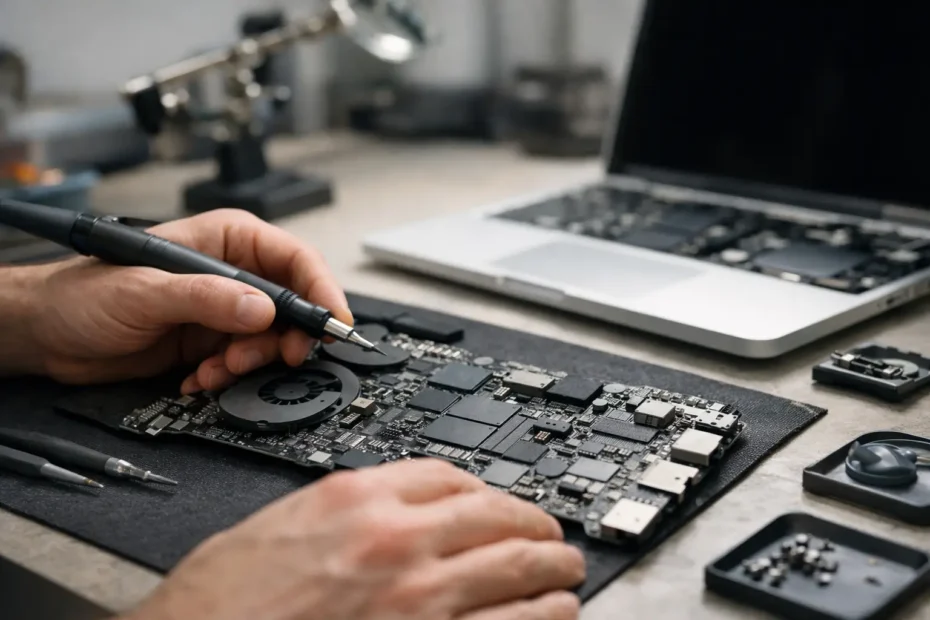
A Mac that suddenly won’t turn on, charges intermittently, shows no backlight, or dies after a spill often gets written off too quickly. The short answer to can Mac logic board be repaired is yes – in many cases, it can. The real question is whether the damage is repairable at the component level, whether the repair is financially sensible, and whether the shop doing the work actually has the skill to diagnose the board instead of guessing.
That distinction matters. Plenty of places can replace a screen or battery. Logic board repair is different. It requires board-level diagnostics, schematics knowledge, microsoldering skill, and the patience to find the failed component instead of swapping major assemblies and hoping for the best.
When can Mac logic board be repaired?
A Mac logic board can often be repaired when the fault is isolated to specific components such as power rails, charging circuits, backlight circuits, USB-C controllers, corroded pads, damaged connectors, or shorted capacitors. Those are the kinds of failures that a board-level technician can trace, test, and repair without replacing the entire board.
This is especially common after liquid exposure. A spill does not automatically mean the whole board is gone. Sometimes the corrosion is limited to one area, and the machine can be restored if that damage is addressed early. The longer a liquid-damaged Mac sits, the more likely corrosion spreads, traces weaken, and multiple circuits become affected.
Physical damage can also be repairable, but it depends on where it occurred. A broken connector or torn pad near a flex cable may be fixable. Major board cracks, severe burn damage, or multiple missing layers inside the board are much harder and sometimes not worth pursuing.
Age is another factor. Older Intel-based Macs and newer Apple Silicon models both can have board-level failures, but the repair path may differ. Some models are more repair-friendly than others, and certain failures are more common on specific generations.
What logic board repair actually means
Many customers hear “logic board issue” and assume that means replacing the entire board. That is not the only option. In a true board-level repair, the technician tests the failing circuit, identifies the bad component or damaged area, and repairs that section directly.
That might mean replacing a charging IC, restoring a corroded trace, replacing a backlight fuse, repairing a damaged keyboard connector, or resolving a short on a main power rail. The goal is to save the original board when possible, which also preserves the machine’s existing pairing and, in many cases, helps avoid the cost of replacing a full assembly.
This approach is often the difference between a reasonable repair bill and a replacement quote that makes the customer feel forced into buying another Mac.
Common symptoms that point to a repairable board problem
Some symptoms strongly suggest a board-level issue rather than a battery, screen, or software problem. These include no power, no charging light or charging response, random shutdowns, battery not detected, no image with a working display backlight, no backlight with a visible image, liquid damage, or USB-C ports that stopped negotiating power properly.
That said, symptoms overlap. A black screen might be a display issue, a backlight circuit problem, or a board that never fully boots. Proper diagnosis comes first.
When logic board repair may not make sense
Not every Mac is a good candidate. If the board has severe multi-layer damage, heavy corrosion across several sections, previous failed repair attempts, or catastrophic damage from the wrong charger or electrical surge, the time and parts required may outweigh the value of the machine.
There is also the reality of economics. A repairable board is not always a smart repair. If the Mac is very old, has low resale value, and also needs a battery, keyboard, and screen, putting major money into it may not be the best move. On the other hand, if the machine contains critical data, supports key software, or replacing it would cost far more, logic board repair can be the clear winner.
This is where honest diagnosis matters. A trustworthy shop should tell you when repair is realistic and when you are better off putting that money toward another device.
Why Apple and many shops say no
Apple and general repair shops often do not perform component-level logic board repairs. Their standard process is usually board replacement, top case replacement, or full unit replacement. That works for workflow efficiency, but it does not help much when the replacement cost is high or the machine is no longer supported.
A shop without microsoldering capability may label a Mac “not repairable” simply because they do not repair boards in-house. That is very different from a board that truly cannot be repaired.
If you have been told your Mac needs a new logic board, it is worth asking whether anyone actually traced the fault to a specific circuit. A diagnosis based on symptoms alone is not the same as a real board assessment.
Can Mac logic board be repaired after liquid damage?
Yes, and this is one of the most common cases where board-level repair makes a major difference. Liquid damage often starts with a short, corrosion, or a failed power or backlight circuit. If handled properly, the board may be repairable and the data may still be recoverable.
Speed matters here. Turning the Mac off, disconnecting power, and getting it inspected quickly gives the best chance. Continuing to use a wet or contaminated board can turn a localized repair into widespread damage.
There is a trade-off, though. A successful repair after a spill does not erase the fact that the board was exposed. A good technician can clean, repair, and stabilize the affected area, but long-term reliability depends on how much contamination occurred and how long it was left untreated.
What affects the cost?
The cost of logic board repair depends less on the model name and more on the actual fault. A simple backlight circuit repair is very different from chasing an intermittent short that only appears under load. The extent of corrosion, part availability, prior repair damage, and how much time diagnosis requires all affect pricing.
This is why flat assumptions are risky. A MacBook Pro with “no power” could need a relatively straightforward power rail repair, or it could have several damaged circuits. Two machines with the same symptom can have completely different repair paths.
Transparent shops will usually start with diagnosis, explain what failed, and then quote based on the real work required. That is much better than guessing from the front counter.
Choosing the right repair shop matters as much as the repair
Board-level work is specialized. If the technician is not experienced, a repairable Mac can become less repairable after poor handling, overheated pads, lifted traces, or incorrect parts installation. This is one area where the cheapest option is often the most expensive in the end.
Look for a shop that can explain the problem clearly, not just tell you the board is bad. You want direct answers about what circuit failed, whether there is corrosion, whether data is at risk, and whether the repair is expected to be stable.
That direct communication is a big part of why specialized shops stand out. At YourMac.Repair, customers work directly with Eduardo, a technician with decades of Apple experience, which means the person diagnosing the board is also the person explaining what is actually wrong and what your options are.
Repair, replace, or recover data?
Sometimes the main goal is not saving the Mac itself. It is saving the files. If the machine has critical business documents, creative work, photos, or client data, logic board repair may be the fastest path to data recovery even if full long-term use is uncertain.
Other times, repair is the better investment because the Mac still has plenty of useful life left. A quality board repair can extend that life significantly, especially when the rest of the machine is in good shape.
And sometimes replacement is the right call. A good technician should be willing to say that too.
If your Mac has a board-level failure, the answer is not to assume it is done. A lot of machines that seem dead are still very repairable in the right hands. The best next step is a real diagnosis from someone who repairs logic boards every day, because the difference between “unrepairable” and “fixable” is often expertise.
Need Mac or iPhone repair in Winter Garden / Orlando?
YourMac.Repair — board-level Apple repair with honest diagnosis and fast turnaround. We say YES when Apple says NO.
- Mac Logic Board Repair — liquid damage specialist
- Mac Screen Repair
- Mac Battery Replacement
- Mac & PC Data Recovery
- iPhone Screen Repair — same-day service
📞 (407) 580-9965 · WhatsApp · 819 Marsh Reed Dr, Winter Garden, FL 34787